

How Do Filtered Earplugs Let You Hear Conversation?
Filtered earplugs let you hear conversation because they turn sound down evenly instead of sealing it off. A small acoustic filter lets a measured amount of sound through, so voices stay clear and natural while the overall volume drops to a safer level. At Big Ear, our filtered earplug, The One, pairs that idea with a custom fit made from impressions of your own ears.
Quick answer
- How they work: a filter lets some sound through on purpose, so you hear voices while the loudness comes down.
- Why voices stay clear: NIOSH describes flat attenuation protectors as reducing noise equally across all frequency bands, which keeps sound natural.
- Why fit matters: a filter can only do its job if the earplug seals well. Custom earplugs are made from impressions of your ears.
- Big Ear’s version: The One has a non-linear canal filter in every pair plus interchangeable flat filters of 9, 15, 20, 25 or 30 dB.
Why do regular earplugs make conversation hard?
Most earplugs are designed to block as much sound as they can. That is perfect for sleeping or for very loud work. At a dinner, a rehearsal or a day at the range, though, you probably want to hear the person next to you.
NIOSH points out that too much sound reduction can make people less aware of their surroundings. In other words, more blocking is not always better. The goal is the right amount of protection for the setting, so you can still talk, listen and react.
Ordinary speech sits around 60 to 70 dBA, according to the NIDCD. The same page lists concerts and sporting events at 94 to 110 dBA. That gap is the whole puzzle: you want to keep the 60 to 70 and take the edge off the 100.
How does a filtered earplug let voices through?
Think of a filtered earplug as a volume knob rather than a door. The body of the earplug seals your ear canal. A small channel with an acoustic filter then lets a controlled amount of sound back in.
The filter is tuned to reduce sound across the range of pitches more evenly. NIOSH calls these flat attenuation protectors (sometimes called musicians’ earplugs) and says they reduce noise equally across frequency bands, which “preserves the fidelity of the sound”. NIOSH also notes they may be helpful where verbal communication is common.
The result feels like someone turned the room down a few notches. Voices sound like voices, music sounds like music, and you aren’t straining to follow along.
What is the difference between flat and non-linear filters?
There are two filter ideas worth knowing, and The One uses both.
A flat filter reduces sound by a steady amount all the time. A 15 dB filter takes about the same bite out of a quiet room as it does out of a loud one.
A non-linear filter changes with the sound. NIOSH describes non-linear, or level-dependent, protectors as devices that let quiet sounds pass through but block loud ones. Ours is analog and has no batteries or electronics. It lets everyday sound through and closes down when sound turns dangerously loud, like a safety valve, then opens again.
| Filter type | What it does | Where it helps |
|---|---|---|
| Flat filter | Turns sound down by a steady amount | Keeping voices and music natural at a lower volume |
| Non-linear filter | Lets everyday sound through, closes down when sound turns dangerously loud | Settings that are mostly calm with sudden loud moments |
| Solid earplug (no filter) | Blocks as much sound as the seal allows | Sleep, focus and steady loud noise where talking isn’t needed |
Why does a custom fit matter for a filtered earplug?
A filter is only as good as the seal around it. If sound sneaks past the edges of an earplug, the filter can’t control what reaches your ear.
That is a big reason fit gets so much attention. NIOSH research on measuring how well earplugs work found that the gap between the label rating and the protection a person actually gets varies widely across protector types and across ear canal sizes and shapes. Everyone’s ears are a little different.
Custom earplugs are built from an impression of your own ear, which NIOSH lists as one of the main styles of earplug. A shell shaped to your canal sits in the same place every time you put it in, so the filter performs the same way each time.
Comfort counts too. NIOSH notes that comfort is what keeps people wearing their hearing protection consistently. A pair you forget you’re wearing is a pair you’ll keep in for the whole set, the whole ride or the whole match.
How does Big Ear build The One?
The One is our filtered custom earplug. Every pair has a two-part, analog, non-electronic filter system:
- A non-linear filter in the canal, built into every pair at no extra cost.
- An interchangeable flat filter on the outside face, in 9, 15, 20, 25 or 30 dB.
The flat filters are color-coded (purple, green, blue, orange and black) and swap in seconds. You don’t need a new mold to change them, so one pair can cover a quiet evening out and a loud afternoon. The One has an NRR of 25 dB with one filter installed, and the filters are interchangeable.
The shells are platinum-cure silicone, Shore A 35, which is hypoallergenic and antibacterial. Each pair is hand-built in the USA from your impressions.
If you ever want more control over the non-linear port, there is a Non-Linear Filter Plug that closes it. It’s a $2.50 add-on with the Standard and Select kits and comes included with Premium.
Which filter should I pick?
Here is our simple starting point. When in doubt, call us and we’ll talk it through with you.
| Setting | Our filter guidance |
|---|---|
| Firearms and the shooting range | 25 or 30 dB |
| Motorcycles | 25 or 30 dB |
| Indoor skydiving (the tunnel) | 25 or 30 dB |
| Around aircraft | 25 or 30 dB |
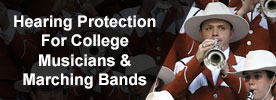
| Marching band | 25 or 30 dB |
| Quieter settings where you mainly want to take the edge off | 9, 15 or 20 dB |
Having two filters on hand can be handy: a lighter one for everyday noise and a stronger one for the loud days. That’s why we offer more than one kit.
Standard, Select or Premium: which kit makes sense?
| Kit | Price | Flat filters included | Also included |
|---|---|---|---|
| Standard | $224.95 | 1 filter set | Non-linear canal filter |
| Select | $299.95 | 2 filter sets | Non-linear canal filter |
| Premium | $574.95 | All 5 | Non-linear canal filter, hole plug, solid plugs, tactical piece and a case |
If you only do one loud thing, Standard is a tidy fit. If your week runs from rehearsals to range days, Select or Premium gives you room to switch.
What happens after I order?
First, we send you our free Home Impression Kit. It ships in 2–3 business days, takes about 10–15 minutes with a helper and a guided video, and comes with a free return label. If an impression can’t be used, a second kit is free.
Your earplugs take 40 business days to build, counted from the day your impressions reach our lab. Order shipping is $10. Every pair comes with our 30-Day Fit Warranty and a 12-month warranty against manufacturing defects (loss isn’t covered). Because each pair is made for your ears alone, custom products can’t be returned, which is why we work hard to get the fit right with you.
We keep your impressions on file for up to ten years, so ordering another pair later is easy. A big change in weight, or 7–10 years going by, can mean it’s time for a fresh set.
Frequently asked questions
Will I hear people clearly with filtered earplugs in?
That’s what they’re designed for. The filter lets a controlled amount of sound through, so voices come through at a lower volume. In very loud places speech will be quieter too, which is why we suggest the lighter filters for calmer settings.
Are filtered earplugs enough for shooting?
For firearms we recommend the 25 or 30 dB filter in The One. Fit matters a lot here, so a custom seal helps. Our shooting hearing protection page has more detail.
Can I change filters without buying new earplugs?
Yes. The flat filters are interchangeable and swap in seconds, with no new mold needed.
Do filtered earplugs use batteries?
No. Both filters in The One are analog and non-electronic, so there is nothing to charge.
What if I already have ringing in my ears?
If you have ear pain, a sudden change in your hearing, or tinnitus that is new or getting worse, please see a doctor or audiologist first. They can check your ears and help you decide what protection suits you.
Ready to hear the room, just quieter?
The WHO notes that exposure to loud sounds, one of the most common causes of hearing loss in adults, is preventable. A comfortable pair you actually wear can help reduce your risk. Start with a free Home Impression Kit, or try Find my pair to match a product to your day. You can also call us at (719) 271-4528. We’re always happy to talk ears.